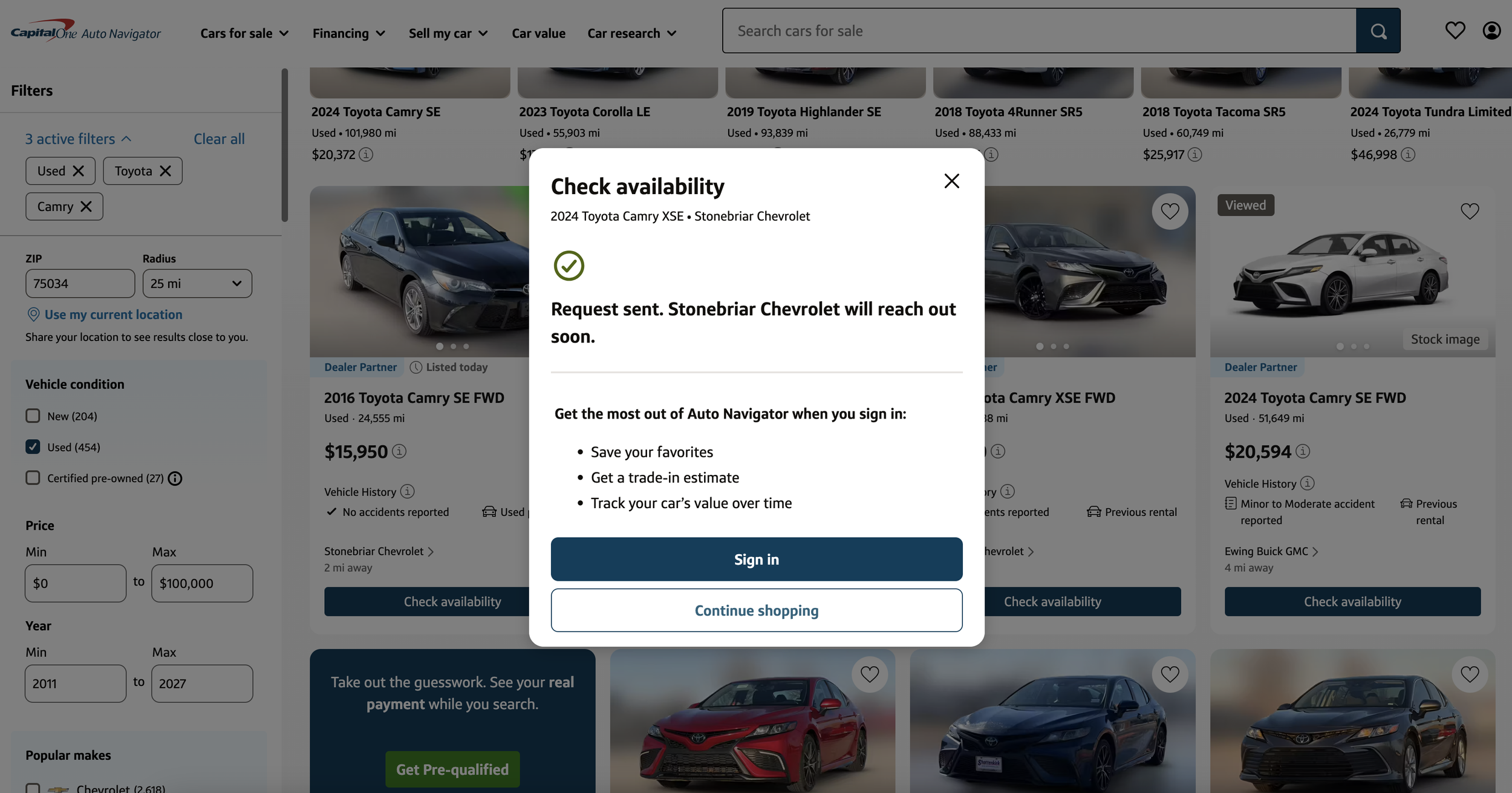
The Context: One of our main Northstar metrics as an org was to increase authentications on the Auto Navigator website. 85% of users browsing our site across both mobile web and desktop are anonymous today. Even those who already have accounts are not often signing in when they visit our website because they lack a clear value proposition to sign in so early in their car-buying journey. Therefore, I wanted to identify high intent moments on the website where we could properly encourage users to sign in or create an account to help boost our authentication rates.

The Challenge: While increasing authentication was a top-level business goal, there was internal tension around when and how to ask users to sign in. Design was concerned about introducing friction too early, while business pushed for more aggressive authentication prompts. At the same time, we lacked strong qualitative data on why users avoided signing in, making it difficult to design with confidence.

WHEN

As I aligned on WHEN we wanted to nudge users to authenticate, it was important that while we raise our primary metric of increased authentications, we don't negatively impact guardrail metrics like overall drop-off from the site or lead completion.

Introducing authentication too early or too aggressively risked adding friction at a moment when users were still exploring, which could undermine trust and prematurely end their journey.

Therefore, I wanted to hone in on specific moments for the anonymous user where they are already considered 'high intent', which makes nudging them a bit more plausible.

HOW

During design jam sessions, we explored multiple approaches to encouraging sign-in. On one end, I did not want to give them a whole spiel about why they should do so & risk cognitive overload. On the other end, I did not just want to stick a sign in button in front of them that lacked sufficient motivation to change behavior.

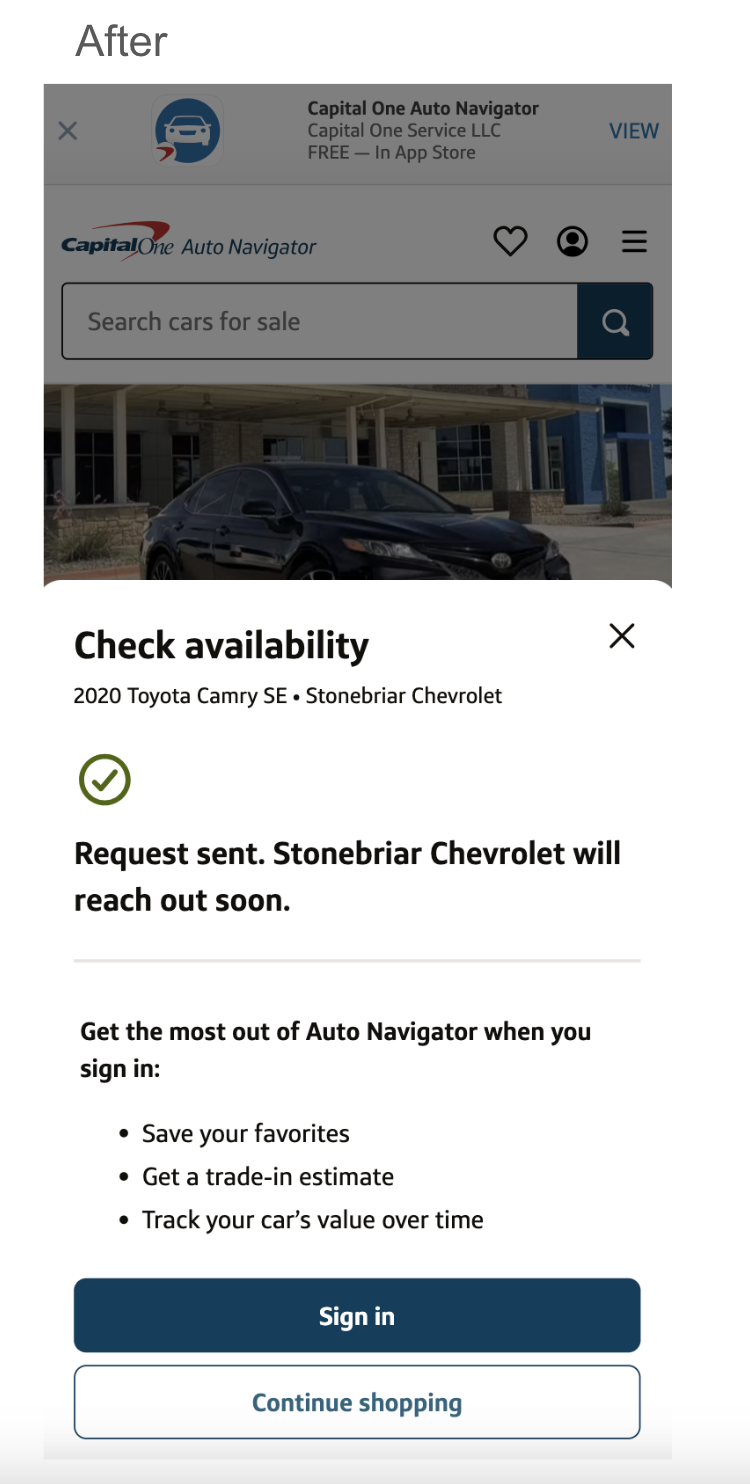
We landed on a middle ground: a lightweight prompt that offered a small set of high-value benefits at a glance to give users a clear & quick reason to take the next step.

WHY

I didn't have qualitative data at the moment to discover why users weren't signing in. But rather than delaying progress (although i do advocate for user research!!!) I supplemented this gap with a competitive analysis.

Across competitor experiences, users were offered more value when it came to certain features, such as saved preferences & personalized recommendations. In contrast, our current experience lacks the same benefit. So while I do want to push users to authenticate, I know there is a bigger problem with product value that we are to work in tandem.

Design takeaway:
These considerations shaped my approach — prompting authentication only at moments of demonstrated intent, communicating value succinctly, and treating this experiment as a way to learn where perceived value and friction truly existed.


Feature Strategy | Identifying high-intent moments across our site for anonymous users

Let’s take you down the path of how I tackled our opportunity statement…..

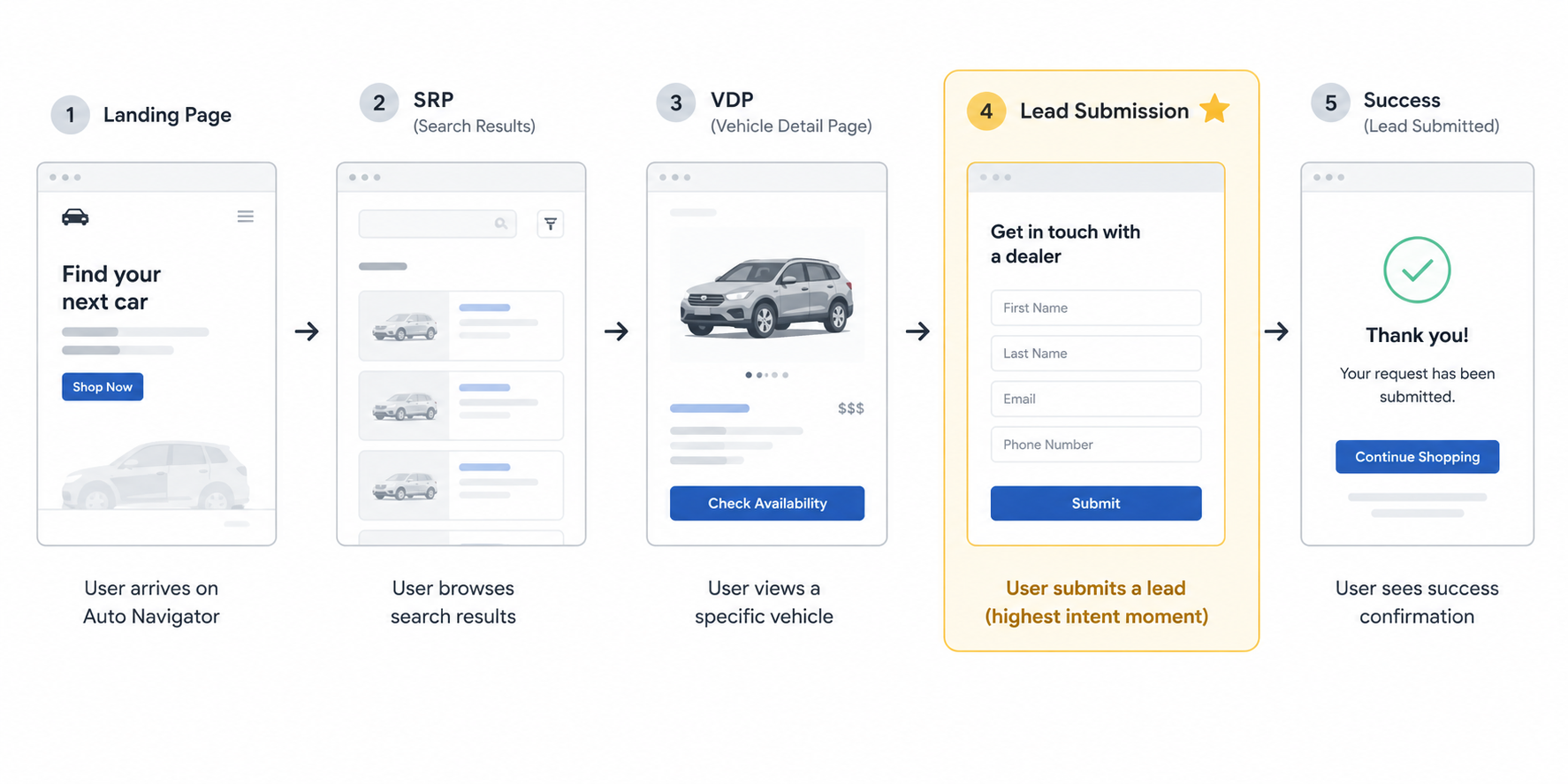
Moment: Anonymous User Submitting a Lead

  • Action: A user clicks "Contact Dealer" or "Check Availability” on a specific vehicle.

  • Why it is high-intent: This is our highest indication of intent on our platform (besides applying for a pre-qualification).

  • Our strategy:

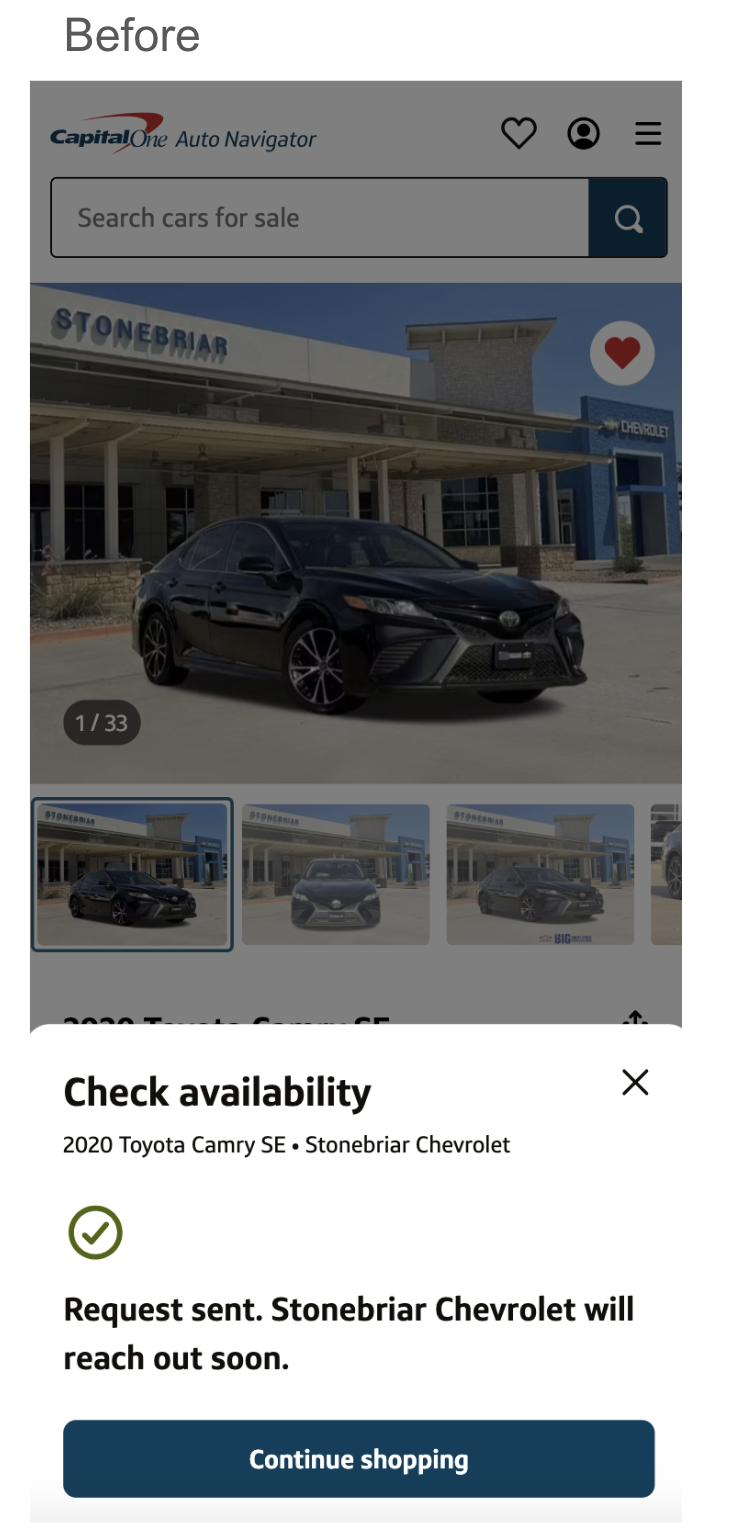
    • Previously, our lead flow was purely transactional, ending with a success screen that encouraged users to "continue shopping." By the time a user reached this screen, their primary goal was complete, and their motivation to authenticate was at its lowest. I identified this as a missed opportunity to capture high-intent users at the absolute peak of their journey. Therefore, I decided to prompt users to authenticate during the lead submission flow, rather than treating it as an afterthought.

    • I intentionally chose a post-lead moment rather than pre-lead gating because it balanced business goals with user trust. Lead conversion is a revenue driver that I don’t want to harm, and the post-lead trigger point made more sense in term of the users car shopping journey.

Because authentication adds friction to the funnel, I launched this as a 25% experiment to carefully monitor impacts to our primary and guardrail metrics.

Definition of Success | What are our North Star metrics?

Primary Metrics

  • % of users clicking on the sign in CTA

  • % of successful authentications coming from users in the experiment vs control

Guardrail Metrics

  • % of leads submitted from users in the experiment vs control.

    • I need to ensure that the "value exchange" we are offering is strong enough that users don't drop off from shopping when asked to sign in.

Results & Data | How Did We Do?

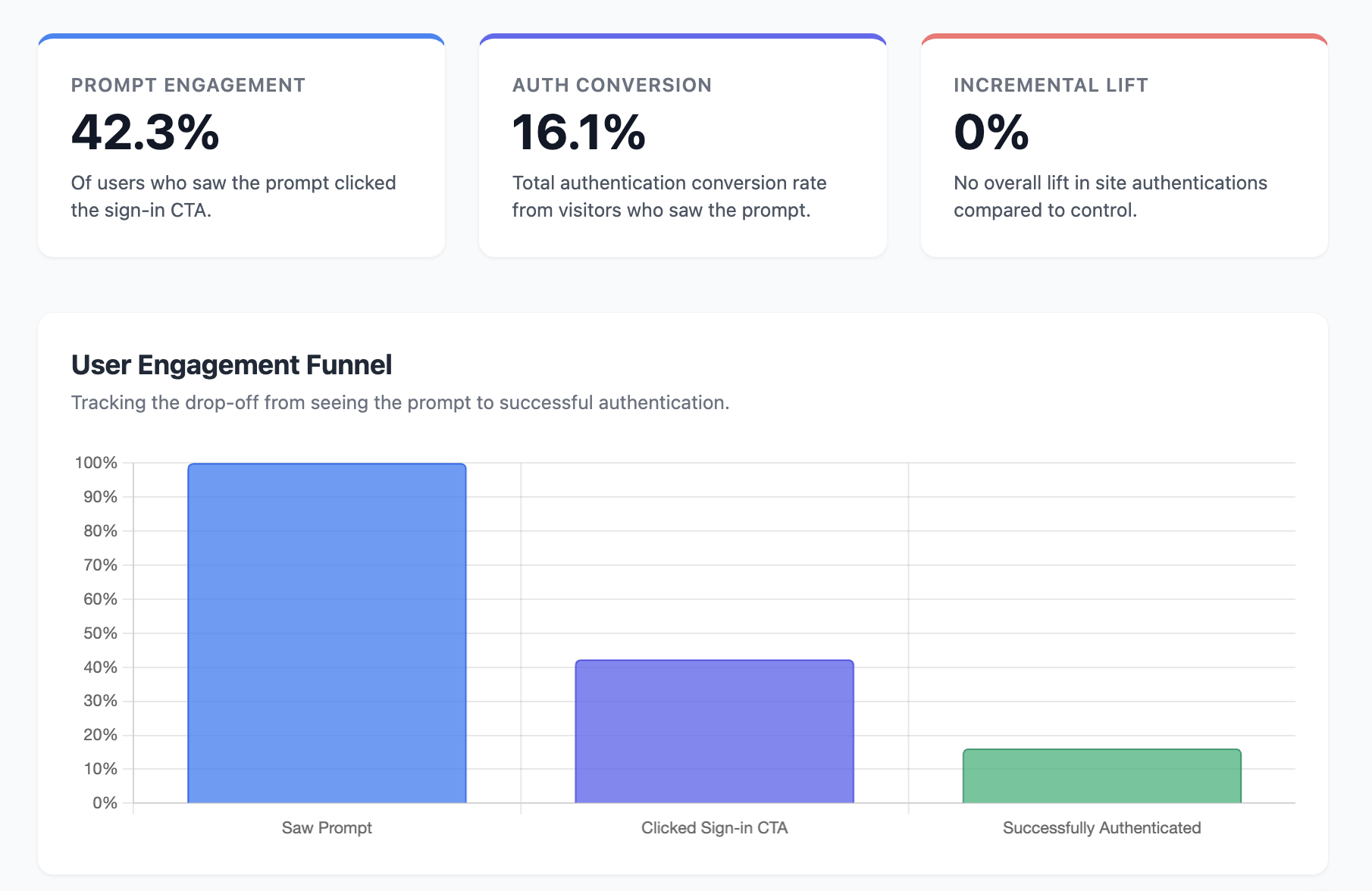
After a few months in market, we have seen a 16% authentication conversion rate coming from visitors who see the prompt! While this may sound great - it is important to understand if we have moved the needle for overall authentications compared to the control.

PRIMARY METRICS

Engagement with new prompt was strong - 42.3% of users who saw it clicked the sign in CTA, and 38.1% of that population successfully authenticated. However, there was no incremental lift in overall site authentications.

Main Takeaway: My hypothesis that a post-lead submission CTA would increase authentication rates has not been proven. The data indicates that the prompt is simply shifting where users authenticate, rather than encouraging new users to sign in.

Additional Learnings: Before deciding to kill the experiment, I wanted to make sure I wasn't leaving signal on the table. Even if the prompt wasn't driving net-new authentications, users who authenticated through it may still be more valuable when it comes to downstream metrics. After pulling that data, downstream metrics showed no meaningful positive impact either.

Final Decision & Next Steps: While the experiment did not drive incremental authentications, it uncovered a valuable insight: users are willing to engage with additional actions after submitting a lead. With nearly 50% of users clicking the authentication CTA, I validated the post-submission screen as a high-intent moment in the shopping journey. Based on these findings, I recommended sunsetting the experiment and reallocating this real estate to experiences that provide more immediate value, such as surfacing similar vehicles or helping users evaluate their trade-in value. The experiment ultimately shifted our thinking from optimizing when to ask users to authenticate toward identifying the most meaningful next step we can offer at a moment of demonstrated intent.

GUARDRAIL METRICS

The lead submission rate remains consistent between experiment & control, indicating that the presence of the CTA is not causing shoppers to abandon the lead process.

Main Takeaway: Our feature is ‘safe’ but has not impacted shopping behavior.

Next
Next

Capital One - Homepage Carousel